
A water heater leaks from one of four places: the drain valve, the temperature and pressure relief valve, the inlet and outlet connections, or the steel tank shell. Three are repairable and one means the tank is finished. This guide shows how to find the source, what each unit type leaks, what the repair costs in Lancaster, and how to stop leaks before they start.
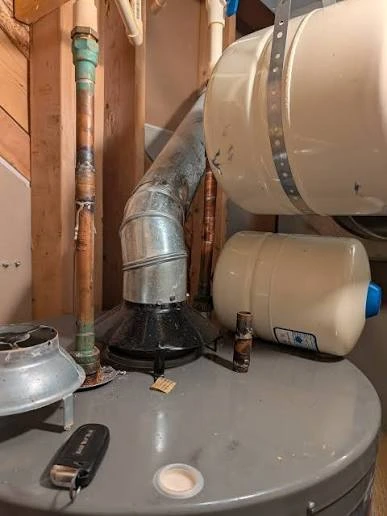
The Four Sources Of A Water Heater Leak
A water heater leaks from a failed drain valve, a discharging T&P valve, loose connections, or a corroded tank shell. Finding the source is the whole job: a drip at the bottom-front points to the drain valve, water at a side pipe points to the T&P valve, moisture at the top points to the connections, and water seeping from the base of the tank itself points to a rusted shell. The first three are serviceable; the last is not. Water appearing at floor level is the hardest of these to read correctly — water heater leaking from the bottom works through that differential in full.
Where Do Water Heaters Leak By Type?
Each water heater type has its own common leak points. Knowing the type narrows the search before a technician arrives. The table below maps the usual leak sources by unit type.
| Water heater type | Most common leak points |
|---|---|
| Gas tank | Drain valve, T&P valve, tank shell above the burner, top connections |
| Electric tank | Drain valve, T&P valve, element gaskets, corroded shell |
| Tankless (gas) | Isolation valves, internal fittings, heat exchanger, condensate line |
| Hybrid heat pump | Drain valve, T&P valve, condensate drain pan and line |
How Do You Tell Where The Leak Is Coming From?
The height of the water on the tank tells you the source. Dry the area, lay down paper, and watch where moisture returns. Water at the top means the cold-inlet or hot-outlet connections; water at a side pipe means the T&P valve; a drip at the bottom-front means the drain valve; and water pooling from the base means the shell. This one check saves an unnecessary tank replacement when the real culprit is a $20 valve.
Is It The Drain Valve?
A drain valve leak shows as a drip from the spigot at the bottom-front of the tank. The valve loosens or fails to reseat after a flush, and it reseals with a cap or replaces at low cost.
Is It The T&P Valve?
A leak from the temperature and pressure relief valve means the valve is relieving pressure or wearing out. Steady discharge points to high system pressure, which a pressure reducing valve or expansion tank corrects; a worn valve is replaced. A discharging T&P valve is a safety signal, not a nuisance.
Is It The Connections?
Moisture at the top of the tank points to loose inlet or outlet connections. The fittings and nipples loosen over years of heating and cooling; they tighten and reseal, and corroded fittings are replaced.
Is It The Tank Shell?
Water seeping from the base means the steel shell has rusted through, and that cannot be repaired. The sacrificial anode rod protects the tank by corroding in its place; once it is spent, the steel rusts and weeps. mineral-bearing water speeds that corrosion and shortens tank life.
Water pooling under the tank? Call (717) 500-8528 to schedule water heater repair in Lancaster.
Schedule Service NowLeak Or Condensation? How To Tell
Condensation drips are normal on a new tank or in humid weather and clear on their own; a true leak returns and grows. Cold inlet water on a hot tank can bead and drip like a leak, especially right after a big hot-water draw. Wipe the tank dry and watch: condensation will not come back once the tank stops recovering, while a leak reappears at the same spot. If water keeps returning, treat it as a leak.
The Cost To Fix A Leaking Water Heater
Fixing a valve or connection leak is inexpensive; a leaking tank shell means replacement. No Lancaster-specific repair-cost study exists, so the figures below are placed within the published national repair range ($228–$1,017, averaging near $615, Angi 2026 data) based on typical part and labor complexity, not an independently sourced figure per row. These are national planning ranges, not fixed quotes or Lancaster-specific data.
| Leak source | Fix | Estimated cost |
|---|---|---|
| Drain valve | Reseal or replace valve | $150–$300 |
| T&P valve | Replace valve (add expansion tank if needed) | $150–$400 |
| Inlet / outlet connections | Tighten or replace fittings | $150–$350 |
| Corroded tank shell | Full replacement (not repairable) | $1,200–$4,500 (national range) |
A full cost breakdown by type, brand and issue sits on the water heater repair cost in Lancaster, PA guide.
When A Leaking Water Heater Becomes An Emergency
A steady leak from the tank shell is an emergency because the tank can fail and flood the space. Take these steps in order, or go straight to emergency water heater repair in Lancaster, PA for the full triage list:
- Shut off the water at the cold-inlet valve above the heater.
- Cut the energy — turn the gas control to off or trip the electric breaker.
- Drain if needed — attach a hose to the drain valve to lower the water level.
- Call for service — a technician confirms whether it is a part or the tank.
A slow drip from a valve is less urgent, but it still needs prompt repair before it worsens. Lancaster Water Heater Pros is available 24/7 for a leaking tank; details are on the water heater repair in Lancaster, PA page.
Repair Versus Replacement For A Leaking Tank
A valve or connection leak is repaired; a leaking steel tank shell is replaced. If the tank itself has rusted through, no patch lasts, and the unit moves to water heater installation in Lancaster, PA. If the leak is a valve or fitting on a tank under 10 years old, the repair is straightforward and far cheaper than a new unit.
Preventing Water Heater Leaks Before They Start
Prevent leaks by slowing corrosion and controlling pressure. Three habits do most of the work, especially where a supply carries a heavy mineral load:
- Replace the anode rod on the manufacturer's recommended schedule so it corrodes instead of the tank.
- Flush the tank on the manufacturer's recommended schedule to clear the sediment that pits the steel.
- Add an expansion tank or pressure reducing valve if system pressure is high, to stop the pressure cycling that stresses fittings and the T&P valve.
Why is your water heater leaking? It comes down to those four sources — a valve, a fitting, or the tank itself — and the fix ranges from a quick, cheap valve swap to a full replacement. Lancaster Water Heater Pros traces the leak and fixes what can be fixed across Lancaster County.
Leaking Water Heater FAQ
Why is my water heater leaking?
From the drain valve, the T&P valve, loose connections, or a corroded tank shell. The first three are serviceable; a rusted shell requires replacement.
Is a leaking water heater an emergency?
A steady leak from the tank shell is — it can flood. Shut off the water and the gas or breaker, then call. A slow valve drip is less urgent but still needs prompt repair.
How much does it cost to fix a leaking water heater?
A valve or connection leak is generally a low-cost repair within the published national repair range ($228 to $1,017). A leaking tank shell cannot be repaired and requires replacement, a published national planning range of roughly $1,200 to $4,500.
Can a leaking water heater be repaired?
A valve or connection leak can be repaired; a leaking steel tank shell cannot and calls for replacement.
How can I prevent my water heater from leaking?
Follow the manufacturer's anode rod and flush schedule, shortening both if a water test shows a heavy mineral load, and control pressure with an expansion tank or pressure reducing valve.
Who fixes a leaking water heater near me in Lancaster?
Lancaster Water Heater Pros handles leaking water heaters across Lancaster City and Lancaster County, including emergency shut-off guidance over the phone. Call (717) 500-8528 at any hour.