
Water under a water heater is not automatically a dead water heater — but it might be, and the difference is worth ten minutes of careful looking. Four of the five sources are components that bolt on and come off again: the drain valve, a supply fitting, the relief valve discharge line, and plain condensation. The fifth is the steel tank itself, which cannot be repaired at any price. This guide is about telling them apart. For leaks originating higher up the unit, see why a water heater leaks, which covers the full range of leak locations.
First: Stop The Water If It Is Flowing
A dripping tank is urgent. A flowing tank is an emergency, because it will keep refilling from the supply line and releasing what it refills. If water is actively running, shut the cold water supply valve on top of the unit, then shut off the power at the breaker for an electric unit or set the gas control to off for a gas unit. Full shutdown steps are in how to shut off your water heater in an emergency.
Two situations need immediate attention no matter how slow the leak: water reaching electrical connections or a gas burner assembly, and a relief valve discharging continuously. Both are covered on emergency water heater repair in Lancaster, PA.
The Five Sources, And What Each Looks Like
Dry everything completely, then watch where water comes back. That single step resolves most cases, and dry paper towel laid around the base makes the reappearance obvious.
| Source | Where the water appears | Outcome |
|---|---|---|
| Drain valve | At the valve spout or its threads, front of unit at floor level | Repairable |
| Supply or fitting connection | Trail running down the outside of the tank from above | Repairable |
| Relief valve discharge line | At the open end of the discharge pipe near the floor | Investigate — symptom, not the fault |
| Condensation | Even beading across the tank exterior, no single trail | Not a leak |
| Tank shell perforation | From beneath the jacket, no fitting above it, rust staining | Replacement |
The Drain Valve
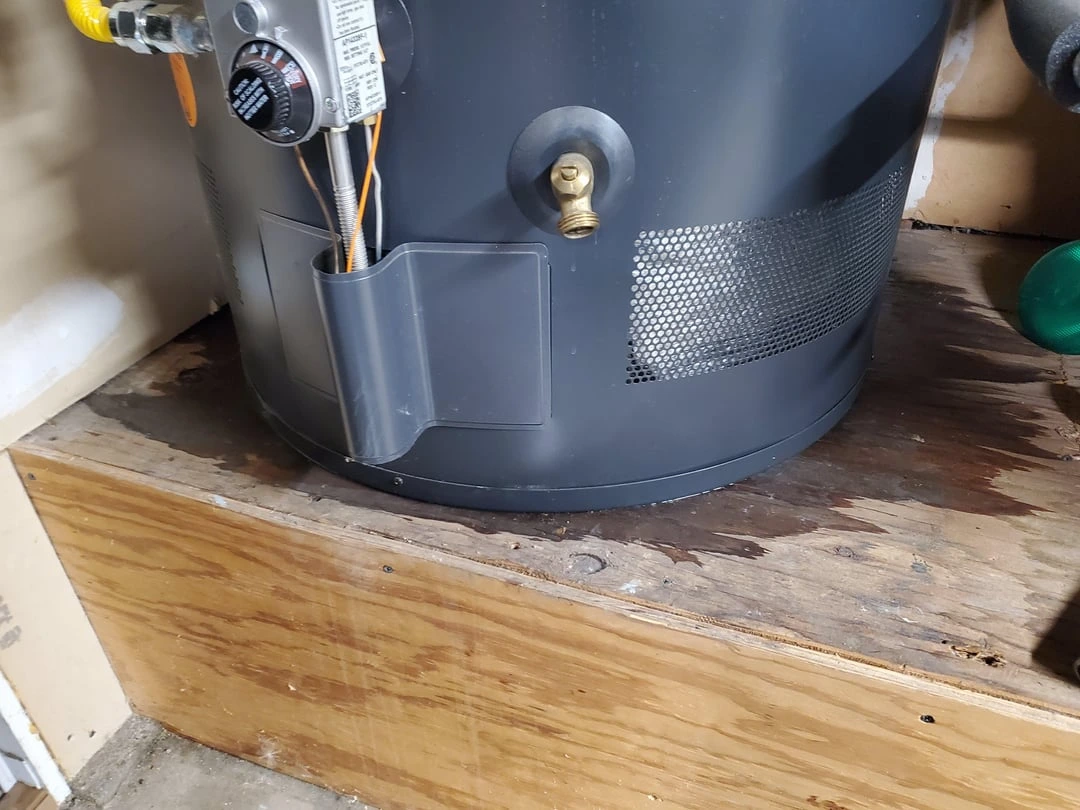
The drain valve sits at the base of the tank and is a routinely replaced component. Older models use plastic valves that become brittle with years of heat cycling. Sediment can lodge in the seat and hold the valve fractionally open. And a valve opened for the first time in years to perform a flush often refuses to reseat afterwards.
The tell is location: water at the valve itself, at the front of the unit, with dry sheet metal above it. Confirm the valve is fully closed first, since a partly turned handle produces exactly this symptom. If it is closed and still weeping, the valve needs replacing — a component job, not a tank job.
Fittings And Supply Connections
A leak at the cold inlet or hot outlet runs down the outside of the tank and pools at the bottom, which makes an upper-body leak look like a bottom leak. This is an easy misdiagnosis to make, and it is worth ruling out precisely because the outcome is so much better than the alternative. Follow the moisture upward with a dry hand or a paper towel. If there is a trail leading up to a fitting, the tank is fine and a connection needs attention.
The Relief Valve Discharge Line
The temperature and pressure relief valve has a discharge pipe that terminates near the floor by design, and water arriving there is the valve doing its job. The question is why it opened. A T&P valve discharges because pressure or temperature exceeded its rating, or because the valve itself has failed to reseat. Excess pressure often traces to thermal expansion in a closed plumbing system without a working expansion tank.
Water at the base of a discharge line is therefore a symptom pointing at a system condition, not a leak in the ordinary sense. It should not be capped, plugged or ignored — that valve is the tank's primary protection against over-pressure.
Condensation
Condensation is real, common, and frequently mistaken for a failing tank. A cold tank surface in a humid basement will bead with moisture that runs down and pools. It appears on a newly installed unit, after a heavy draw has refilled the tank with cold water, and in humid weather.
The distinguishing feature is the pattern: even beading across the whole exterior rather than a trail from a point. And it resolves — once the tank reaches temperature, condensation stops. Moisture still present after the unit has been hot for several hours is a leak.
Water under the tank and no obvious source? Call (717) 500-8528 to get the leak located before it decides for you.
Schedule Service NowWhen It Is The Tank Itself
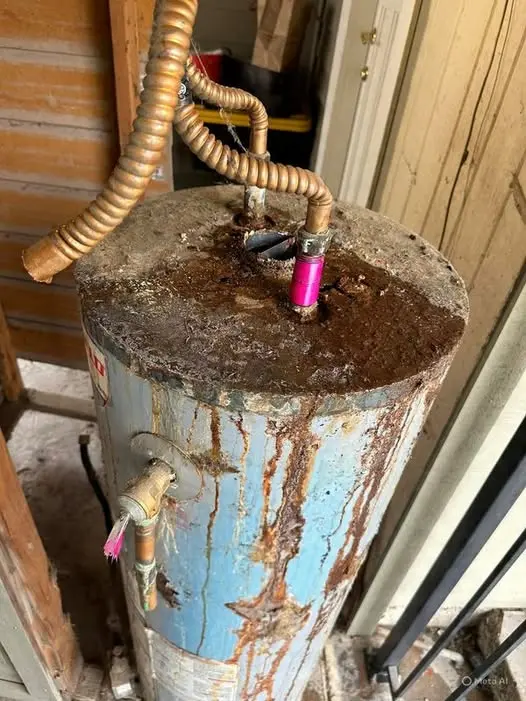
A storage water heater is a steel vessel with a thin glass lining, and that lining is the only thing standing between the water and the steel. The anode rod exists to corrode preferentially so the tank does not. When the anode is exhausted and not replaced, corrosion moves to the steel, and it works outward from the inside until it perforates.
By the time water appears, the failure has been developing for a long time. The signs that point this way are water emerging from beneath the sheet metal jacket with no fitting above it, rust staining at the base, rust-coloured water at the taps, and a unit at or past the U.S. Department of Energy's stated 10 to 15 year service life for conventional storage tanks.
A perforated tank cannot be repaired. Not welded, not patched, not sealed. It holds household water pressure continuously, and any repair to a corroded pressure vessel is a failure waiting for a worse moment. Anyone offering to patch one is not doing you a favour. Replacement options and sizing are on water heater installation in Lancaster, PA.
What It Costs To Resolve
Component repairs and tank replacement sit in very different places. Published national planning range: $228 to $1,017 per repair call, averaging near $615 (Angi, 2026 data) — that covers valve and fitting work. For replacement, published national planning range: $1,200 to $4,500 fully installed across all unit types (Angi, 2026 data).
Both are national figures and are not Lancaster-specific. Actual cost turns on unit type, capacity, venting, any code-required upgrades and the site itself. This is general planning information, not a quote — call (717) 500-8528 for a property-specific number.
What To Do Before The Technician Arrives
- Shut the cold supply valve if water is flowing rather than dripping.
- Cut power or gas to the unit — a tank that loses water while still firing can be damaged further.
- Move anything stored nearby. A tank that has started leaking can fail more completely without warning.
- Photograph where the water appears. This is genuinely useful, since the floor may be dry again by the time anyone arrives.
- Note the unit's age from the serial number on the label. It changes the repair-versus-replace calculation.
A bottom leak deserves a same-week answer even when it looks minor. Tanks do not heal, and the failure mode they progress toward involves the entire contents on the floor. Water heater repair in Lancaster, PA covers how that assessment runs.
Bottom Leak FAQ
Can a water heater leaking from the bottom be repaired?
It depends entirely on what is leaking. Water from the drain valve, a supply connection, or the relief discharge line is a component problem, and components get replaced. Water coming through the tank shell cannot be repaired — a storage tank is a steel vessel with a glass lining, and once corrosion has perforated it, no patch or sealant restores it safely under continuous household pressure.
How do I tell if it is the tank or just the drain valve?
Dry everything thoroughly, then watch where water reappears. A drain valve leak shows at the valve spout or threads, near the front at floor level. A tank leak appears from beneath the jacket with no identifiable fitting above it, often with rust staining at the base. Dry paper towel around the base, checked after an hour, usually settles it.
Is water under a water heater an emergency?
A slow drip is urgent but not an emergency. Active flowing water is an emergency, because a failed tank keeps refilling from the supply line. Shut off the cold water supply and the power or gas, then call. Water near electrical connections or a gas burner, and a relief valve discharging continuously, both warrant immediate attention regardless of flow rate.
Could the water just be condensation?
Yes, and it is worth ruling out before assuming the worst. Condensation forms on a cold tank in a humid space — on a new unit, after a large draw, or in humid weather. It appears as even beading across the exterior rather than a trail from one point, and it stops once the tank is hot. Moisture still present after several hours of operation is a leak.
How much does it cost to replace a leaking water heater?
Published national planning range: $1,200 to $4,500 fully installed across all unit types (Angi, 2026 data). Component repairs instead fall in a published national planning range of $228 to $1,017 per call, averaging near $615. Both are national, not Lancaster-specific. This is general planning information, not a quote — call (717) 500-8528 for a property-specific number.
Who fixes a water heater leaking from the bottom near me in Lancaster?
Lancaster Water Heater Pros diagnoses leaks across Lancaster City and Lancaster County, and the first job on site is establishing whether the leak is at a component or through the tank shell, because that answer determines everything that follows. If the tank has perforated, replacement sizing is worked out at the same visit. Call (717) 500-8528. Service requests are accepted 24/7, and same-day appointments may be available.