
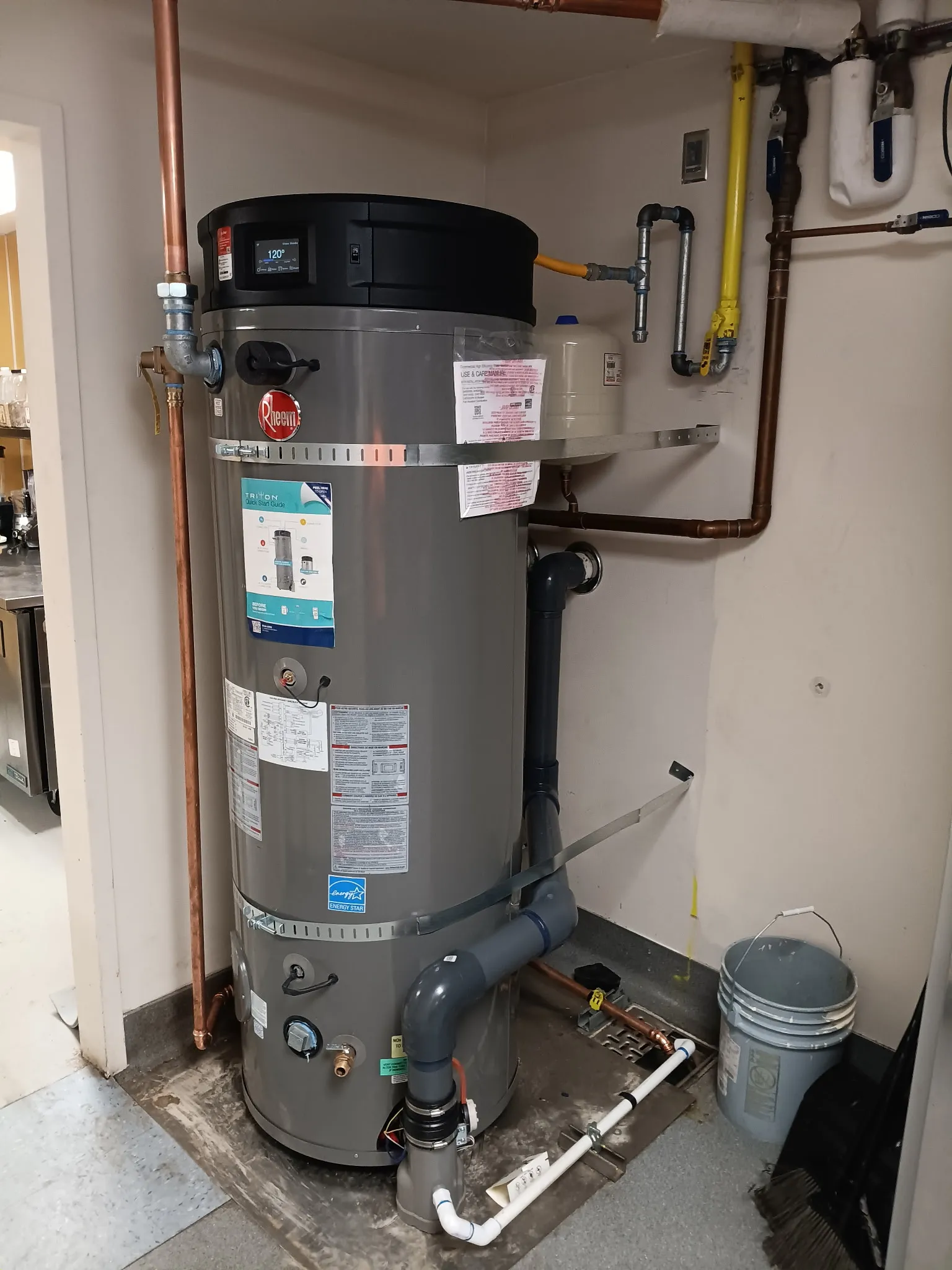
An expansion tank exists because heated water takes up more room and a closed plumbing system gives it none. A. O. Smith’s Technical Bulletin 45 puts it plainly: water expands when heated, and water will not compress the way air does, so system designers must make provision for the expansion. Whether your house needs that provision depends on whether the water supply into it is open or closed, and that is not something you can see by looking at the heater.
What Thermal Expansion Is
Thermal expansion is the rise in volume, and in a closed system the rise in pressure, when water is heated. The A. O. Smith bulletin illustrates the stakes with one figure: water in a closed tank at 50 psi, heated just 10 degrees, will reach a pressure of 250 psi. That is the bulletin’s illustration of why the expansion has to be accommodated, not a prediction for any particular house.
What Makes A Water System Closed
A system becomes closed when something in the supply line stops expanded water from flowing back out toward the street. A. O. Smith names three: check valves at the water meter, which the bulletin says are often required by code and which some cities are installing; pressure reducing valves, many of which also act as check valves; and water softeners in the system, which may also act as backflow preventers. State Water Heaters’ electric manual says the same thing in its own words: devices such as pressure reducing valves, check valves and backflow preventers that have no internal bypass “cause the water system to be closed.”
Neither document says you should remove those devices. A. O. Smith says twice, of the check valve and of the pressure reducing valve, “Do not remove them!” The answer they give is to provide for the expansion.
If a softener is the device in question, our water softener and water heater guide covers the other effects it has on the heater.
How It Shows Up In A House
The bulletin lists symptoms that appear after hot water use is followed by a period of no use. A relief valve that drips during a recovery cycle, hot water pipes that creak while the heater recovers with all valves closed, faucets that drip during recovery, and water that surges when a valve is first opened. It also lists components in the water system failing prematurely, and warns that failures caused by uncompensated thermal expansion are not covered by the manufacturer’s warranty. Our T&P relief valve guide covers the first symptom in detail.
The bulletin also describes a pressure test using a gauge on the drain valve to confirm a closed system. It involves a hot tank and an open drain, so we mention that it exists rather than walking you through it.
Not sure whether your system is closed? Call (717) 500-8528 and we will talk through what you are seeing.
What The Tank Does
The tank holds a sealed cushion of air that absorbs the expanded water and gives it back afterwards. Amtrol’s installation instructions for its Therm-X-Trol ST-447C through ST-457C thermal expansion absorbers describe the sequence. The sealed-in air pre-charge keeps water out of the tank until system pressure exceeds the pre-charge. As water temperature rises, expanded water enters the tank’s reservoir and the air chamber absorbs the pressure increase, keeping system pressure below the relief valve setting. As hot water is used, the air chamber pressure pushes water back into the system.
Amtrol’s instructions also set out what installation involves, and it is the reason this is a job for a professional. The product “must be installed by a licensed professional.” The air pre-charge is adjusted to equal the incoming pressure. The tank is installed on the supply line to the water heater, between the heater and the backflow preventer, check valve or pressure reducing valve. And a professional plumber should check the heating system, including the tank, yearly and more frequently as the system ages. Those are one maker’s instructions for one range, and other tanks publish their own.
The Fix A. O. Smith Describes
The bulletin’s “ideal fix” is a pressure reducing valve where supply pressure is high, plus a properly sized expansion tank. Specifically, it calls for the valve if supply pressures are above 60 to 70 psi, says the valve reduces supply pressure to 40 to 60 psi so that an economical tank can be used, and notes the valve is not required if the system already has one. The valve goes between the check valve and the water heating system, and the tank between the valve and the heater. It tells the installer to follow the tank manufacturer’s instructions, and to repeat the expansion check afterwards.
What An Expansion Tank Costs
Published national planning range: installing a new expansion tank commonly runs $150–$450 in labor, with the tank itself $40–$200 depending on size; replacing an existing one runs $300–$800 total. That comes from Angi’s 2026 data. It is a national range, it is not a Lancaster quote, and it does not include a pressure reducing valve if one is also needed. Property-level conditions decide the real figure, and the quote should say what it includes.
What This Page Will Not Tell You
It will not tell you whether Pennsylvania, or any Lancaster-area municipality, has a rule about expansion tanks. The Pennsylvania Uniform Construction Code provision we have read does not name water heaters, and we have not located a municipal rule we can quote, so we make no statement either way. It will not size a tank for you either: the bulletin says “properly sized,” and the size follows from the heater, the supply pressure and the tank maker’s data. What it does give you are the questions to put to anyone quoting the work, alongside water heater installation in Lancaster, PA and how to choose a water heater contractor.
Relief Valve Dripping Or Pipes Creaking?
Service requests and emergency service are available 24/7 across Lancaster City and Lancaster County.
Call For Emergency ServiceExpansion Tank Questions
Do I need an expansion tank on my water heater?
The manufacturer documents tie it to whether your water supply is a closed system, not to the heater. A. O. Smith and State Water Heaters both say a closed system needs a provision for thermal expansion, and name an expansion tank among the remedies. Whether yours is closed depends on what is in your supply line. We make no statement about what Pennsylvania or any local code says on the point.
How do I know if my plumbing is a closed system?
Look for the devices the documents name: a check valve at the meter, a pressure reducing valve that also checks flow, or a softener acting as a backflow preventer. Their presence, plus the symptoms A. O. Smith lists, such as a relief valve dripping during recovery, suggests a closed system. Confirming it takes a pressure measurement, which is a technician’s job.
Can a T&P valve replace an expansion tank?
No, and both manufacturers say so. A. O. Smith: “do not depend on the T&P valve to handle thermal expansion,” because it was designed as an emergency relief device only. State Water Heaters says the valve “is not intended for the constant relief of thermal expansion.” See our T&P relief valve guide.
Does a water softener make a system closed?
It can, according to A. O. Smith. Technical Bulletin 45 says water softeners in the system may also act as backflow preventers. It lists them alongside check valves at the meter and pressure reducing valves as things that can leave expanded water with nowhere to go.
How much does an expansion tank cost?
Published national planning range: $150–$450 in labor to install a new one, with the tank itself $40–$200 depending on size, and $300–$800 total to replace an existing one. That is Angi’s 2026 national data, not a Lancaster-specific figure or a quote. A pressure reducing valve, where needed, is separate.
Who installs expansion tanks near me in Lancaster County?
Lancaster Water Heater Pros services water heaters across Lancaster City and Lancaster County. Call (717) 500-8528 and describe the symptoms, such as a dripping relief valve or creaking pipes. Service requests are accepted 24/7.