
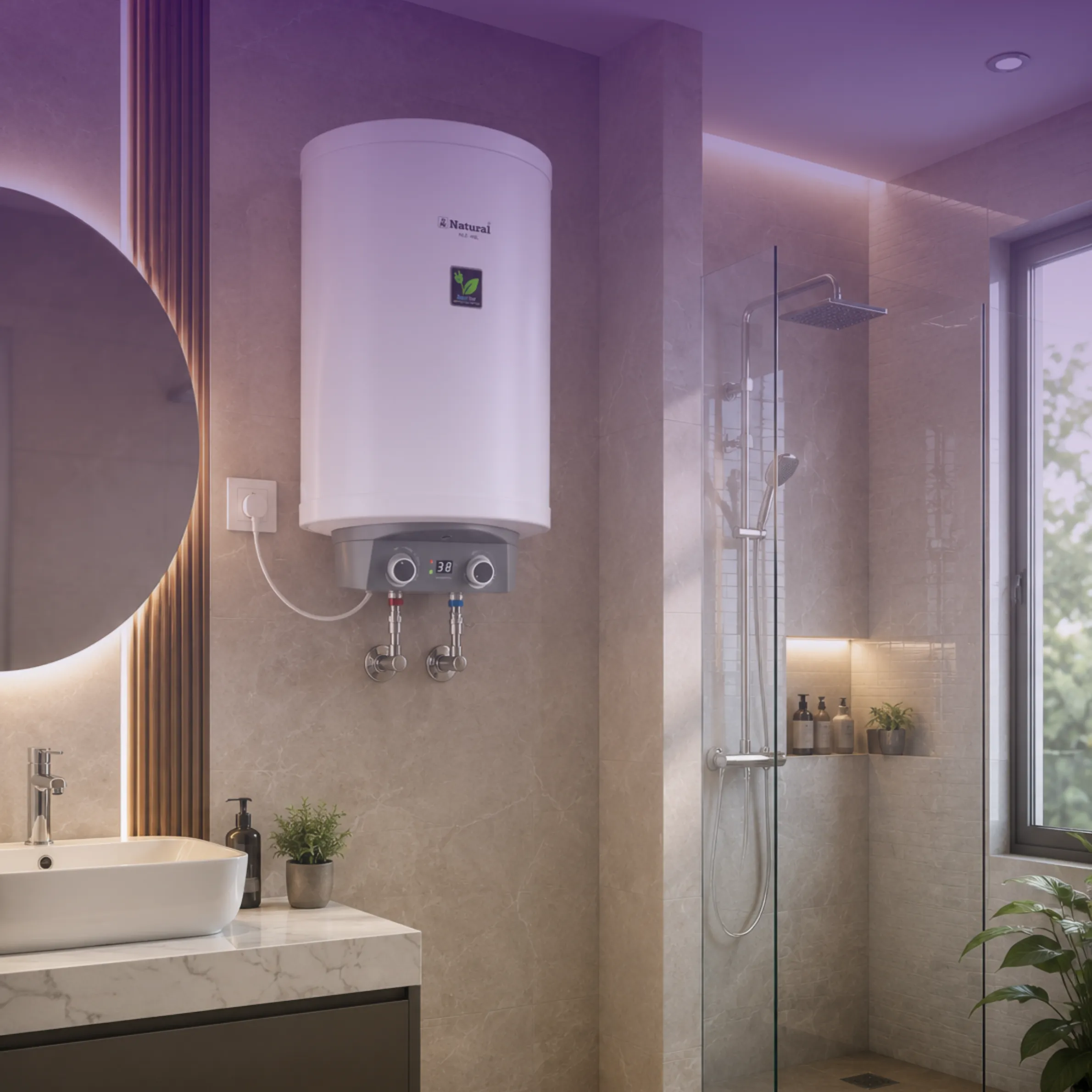
A heat pump water heater does not make heat — it moves heat, pulling warmth out of the surrounding air and pushing it into the tank. That one difference is why it costs a fraction of a conventional electric tank to run, and also why the room it stands in matters more than the model on the box. Deciding on one is a space question, a demand question and an efficiency question, in that order, and Lancaster Water Heater Pros walks a household through all three before quoting.
Still weighing heat pump against gas or standard electric? The gas vs. electric vs. heat pump comparison guide lines up all three side by side on cost, space and hard-water impact.
Reading COP And Efficiency Ratings
Coefficient of performance, or COP, states how many units of heat the unit delivers per unit of electricity it consumes. A conventional resistance element is fixed at roughly one to one — it can never return more energy than it draws. A heat pump, because it relocates ambient heat rather than generating it, returns several times the energy it consumes, and that multiple is what shows up on the utility bill. Manufacturers also publish a UEF, or Uniform Energy Factor, measured over a standard usage pattern, which is the more useful number for comparing two candidate models against each other. Both figures are laboratory ratings taken at defined air temperatures, so the practical yield depends heavily on where the tank actually ends up standing.
Ambient Air Temperature And The Room It Lives In
The unit's fuel is the warmth of the air around it, so a cold room is a poor one. Efficiency falls as the surrounding air gets colder, and below the manufacturer's stated cut-off the unit stops using the compressor and falls back on its resistance elements — at which point it is simply an ordinary electric tank drawing ordinary electric-tank power. In Lancaster County that makes a conditioned or semi-conditioned basement the reliable choice, while an unheated detached garage that drops toward freezing in January will spend a good part of the winter in backup mode. It is also worth knowing up front that the unit exhausts cooler, drier air into the room it draws from: welcome in a damp Lancaster basement in August, less so in a finished space someone is sitting in.
Air Volume, Clearance And Footprint
Manufacturers specify a minimum room volume — commonly in the range of several hundred to a thousand cubic feet — because a sealed closet runs out of extractable heat almost immediately. Alongside that comes a required clearance envelope around the air intake and discharge so the unit is not simply recycling its own chilled exhaust. Height is the other surprise: a heat pump water heater carries its compressor and evaporator on top of the tank, which makes it appreciably taller than the conventional unit it replaces, and a low basement joist or a shelf directly overhead can rule out an otherwise ideal spot. Both the floor footprint and the overhead measurement get taken on the survey visit, not on installation day.
Ducted Or Non-Ducted
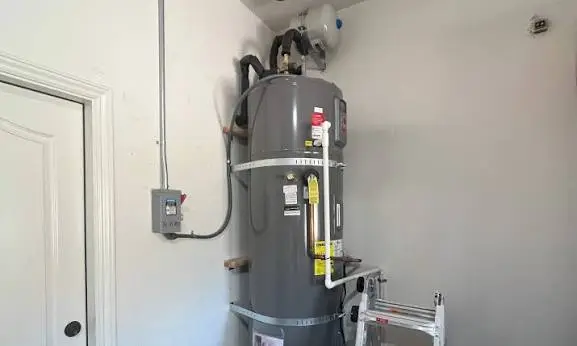
Where the room cannot supply the air on its own, ducting solves it. A non-ducted installation is the standard arrangement: the unit breathes the room directly, which is simplest and cheapest and works wherever the volume requirement is genuinely met. A ducted installation adds intake or discharge ductwork — sometimes both — to draw air from a larger adjacent space or to send the chilled output somewhere it is wanted rather than into a finished room. Ducting is what makes an undersized utility closet workable, and it is the usual answer when the only available location is otherwise perfect but too tight to breathe.
Not Sure If Your Basement Suits One?
We measure the room volume, clearance and overhead height, then tell you honestly whether a heat pump unit is the right buy.
Sizing To Household Demand
Gallon capacity is the headline number, but first-hour rating is the one that predicts whether anyone gets a cold shower. First-hour rating describes how much hot water the unit can actually deliver across a busy sixty minutes starting from a full tank, combining stored volume with how fast it can reheat. Heat pump units recover more slowly than a gas burner does, so the sizing conversation leans toward a larger stored volume than a like-for-like gas swap would suggest. The practical inputs are how many people share the house, how many bathrooms run in the same window, and whether the laundry and dishwasher land in that window too. A household that showers in a tight morning block needs headroom that a staggered household simply does not.
Rebates And Tax Credits
The federal tax credit that previously applied to qualifying heat pump water heaters has expired and does not apply to a 2026 installation — see the FAQ below for the exact detail. State and utility incentive programmes change from year to year and differ by provider, so no figure is quoted here for those; Lancaster Water Heater Pros does not put a rebate number on a quote it cannot verify on the day. Confirm current state and utility terms directly before building any incentive into your budget, and treat the running-cost saving rather than any incentive as the reason the unit pays back.
Measure The Space
Room volume, intake and discharge clearance, and overhead height are recorded against the manufacturer's minimums.
Profile The Demand
Occupancy, bathroom count and peak-hour usage set the stored volume and first-hour rating target.
Settle Ducted Or Not
If the room cannot supply the air alone, intake or discharge ducting is designed into the quote.
Set And Plumb
The unit is set level on its pan, connected with dielectric transitions, and the T&P line is run to an approved termination.
Route Condensate And Commission
The condensate path is piped and proven to drain, the mode is configured, and the first flush interval is scheduled.
Water Conditions And A New Heat Pump Unit
A heat pump water heater has to keep two surfaces clean, and a heavy mineral load in the supply only threatens one of them. On the air side, the evaporator coil and its filter sit in the dust and lint of a basement or laundry room, and a fouled coil chokes the unit's ability to harvest heat — which is why the filter position is checked for reachability during the survey rather than discovered later behind a shelf. On the water side, where a supply carries a heavy mineral load, the same mineral-bearing water that shortens conventional tanks still settles carbonate into this one, and because this unit transfers heat gently across a large area rather than blasting it in through a burner, a scale layer degrades its output proportionally more than it would on a gas tank. Specifying an accessible drain valve and committing to a flush schedule from day one is what protects the efficiency being paid for in the first place.
Who Should Install A Heat Pump Water Heater
An installer who will measure the room before selling the unit is the one worth hiring. Lancaster Water Heater Pros is family-owned, has served Lancaster City and Lancaster County since 2018, and stays with the unit afterwards through heat pump water heater repair in Lancaster, PA. Where the space genuinely will not support one, the honest alternatives are a conventional electric water heater installation in Lancaster, PA or, for homes with gas at the meter, gas water heater installation in Lancaster, PA. The full unit-type comparison sits on the water heater installation in Lancaster, PA page.
A heat pump water heater rewards a household that has the air volume to feed it and the patience to size it properly. Lancaster Water Heater Pros checks both before recommending one.
 RheemProTerra Hybrid
 A.O. SmithVoltex Hybrid
 Bradford WhiteAeroTherm Heat Pump