
Electric water heater installation in Lancaster, PA hinges on what your electrical panel can spare, not on what your chimney can carry. There is no flue, no draft and no combustion air to solve — the questions move to circuit capacity, element wattage and where a tank can stand once venting stops limiting the choice. Lancaster Water Heater Pros checks the panel first, then sizes the unit to it.
The 240-Volt Circuit And Breaker Sizing
A residential electric tank runs on a dedicated 240-volt circuit, and the breaker is matched to the element wattage rather than to the tank's gallon count. The common pairing in Lancaster homes is a 4,500-watt element set protected by a 30-amp double-pole breaker on 10 AWG conductors; a lower 3,800-watt unit or a higher-wattage model shifts that pairing accordingly. The circuit serves the water heater alone — nothing else may share it — and a disconnecting means stays within sight of the appliance so the unit can be isolated without a trip to the panel. Reusing an undersized existing circuit is the shortcut that turns into nuisance tripping and heat-damaged terminals a year later.
Panel Capacity Assessment Before You Order
The panel is assessed before a model is chosen, because a tank that cannot be powered is a tank that cannot be installed. Two things get looked at: whether two adjacent breaker spaces are physically free, and whether the service has headroom left once the existing load is totalled. Older Lancaster City rowhomes on a 100-amp service that already carries a dryer, a range and central air can be genuinely full, and a finished-basement subpanel may be the practical answer rather than a service upgrade. Where the panel is an obsolete or recalled type, the honest recommendation is to correct that first — a new appliance does not fix a bad busbar.
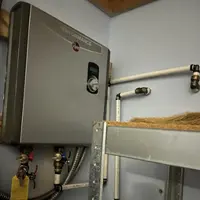
Upper And Lower Element Configuration And Wattage
Most residential electric tanks carry two elements wired in a non-simultaneous arrangement, so only one draws power at any moment. The upper element has priority and reheats the top of the tank first, which is why a partly recovered electric heater gives a short burst of genuinely hot water before it fades. Once the top is satisfied, control passes to the lower element to bring the whole tank up. That layout keeps the current draw to what a single 30-amp circuit can carry, and it is also why element wattage — not tank size — sets recovery speed. Households that run showers back to back benefit more from stepping up wattage and first-hour rating than from simply buying more gallons.
No Flue Means Placement Is Open
Nothing is burned, so nothing has to be exhausted — and that single fact is the biggest practical advantage an electric tank has. The unit does not need a chimney, a B-vent, a sidewall termination or a combustion-air path, which frees it to sit in an interior closet, under a stair, in a laundry alcove or on an upper floor far from any masonry. What still governs placement is service access and water: room to pull an element and reach the drain valve, and a drain pan piped to a safe discharge point wherever a leak would land on finished space below. The T&P relief line still runs full-size and downward to an approved termination, exactly as it would on a gas unit.
Want An Electric Tank Priced For Your Panel?
We check breaker space and service capacity, then quote the installed price on a unit that fits both.
Dielectric Unions And Wiring At The Connection
Two connections decide how long the installation stays trouble-free: the one that carries water and the one that carries current. Where a copper supply meets the steel nipples of the tank, a dielectric union or a brass transition breaks the metal-to-metal contact that would otherwise set up galvanic corrosion and eat the joint from the inside. On the electrical side, the supply enters through a listed connector at the junction box on the tank, the equipment grounding conductor lands on the appliance ground, and every terminal is torqued to the manufacturer's specification rather than to feel — loose lugs are the leading cause of burnt element terminals. Both connections are checked again after the tank is filled and hot, when thermal movement has had its say.
When An Electric Tank Is The Right Call
An electric water heater earns its place in three Lancaster situations. The first is a home with no natural gas service at all, where running a line is disproportionate to the job. The second is a tight interior space — a closet, an alcove, a converted upper-floor room — where no vent could reasonably be routed. The third is an all-electric household already committed to that fuel, where adding a single gas appliance means bringing in a meter, a line and a vent for one tank. In all three, the lower purchase price and simpler installation offset the higher per-unit energy cost, and a household chasing efficiency instead should compare a heat pump water heater installation in Lancaster, PA, which uses the same electrical service far more sparingly.
Assess The Panel
Breaker spaces, conductor size and remaining service capacity are checked before any unit is specified.
Match Wattage To Demand
Element wattage and first-hour rating are set against how the household actually draws hot water.
Isolate And Remove
The circuit is locked out, the old tank is drained and taken away, and the location is prepared.
Set And Connect
The tank is set on its pan, joined with dielectric transitions, wired to torque spec and grounded.
Fill, Energise, Verify
The tank is filled and purged before power is applied, then both elements and the thermostats are proven.
Water Conditions And Electric Elements
An electric element sits immersed in the water itself, which puts it in a harsher position than any gas burner ever occupies. Mineral-bearing water bakes calcium and magnesium straight onto the element sheath as a hard crust; the crust traps the element's own heat against it, the sheath overheats, and it burns out well before the tank does. On a mineral-heavy supply, an element can need replacing more than once over a tank's life for exactly this reason. Two decisions at installation change that arithmetic: specifying low-watt-density elements, which spread the same wattage over more surface and scale far more slowly, and leaving genuine working clearance at the element ports so future service is a short job instead of a wrestling match. Where scale is shortening tank life, both are cheap insurance.
Who Should Install An Electric Water Heater
A contractor comfortable on both the water side and the 240-volt side is the right installer. Lancaster Water Heater Pros is family-owned, has served Lancaster City and Lancaster County since 2018, and supports the same unit afterwards through electric water heater repair in Lancaster, PA. Homes with gas already at the meter should weigh gas water heater installation in Lancaster, PA, and the full comparison of unit types sits on the water heater installation in Lancaster, PA page.
An electric water heater installation is a straightforward job when the panel is honest about what it can carry and the elements are chosen for Lancaster water. Lancaster Water Heater Pros handles both ends of that across the county.
 RheemPerformance Platinum
 A.O. SmithSignature Premier
 Bradford WhiteDefender, Vitraglas
 American StandardElectric Storage