
Gas water heater installation in Lancaster, PA is a fuel-supply and exhaust job before it is a plumbing job — the new unit has to draw enough gas, burn it with enough air, and push every bit of exhaust out of the house. Lancaster Water Heater Pros measures the existing gas line, confirms the vent the new appliance requires, pulls the permit, and sets the tank so it passes municipal inspection the first time.
Gas Line Sizing And BTU Input
Every gas water heater carries a BTU-per-hour input rating, and the branch line feeding it must deliver that volume while the furnace and range are also running. A 40- or 50-gallon residential tank commonly lands between 32,000 and 40,000 BTU/h, and a high-recovery model can climb well past that. A pipe that was adequate for a 1990s low-input tank starves a modern high-recovery burner, which shows up as a lazy flame and slow reheat rather than an outright failure. Before ordering the unit, the technician measures pipe diameter, run length and the total connected load in the home, then upsizes the branch if the new input demands it.
Venting Type And Flue Clearance
The vent style is chosen before the tank is, because it decides where the appliance can physically live. Three configurations cover almost every Lancaster home:
- Atmospheric — exhaust rises on its own buoyancy through a draft hood into a chimney or B-vent. Cheapest to install, but it needs a healthy chimney and generous room air.
- Power vent — a blower pushes exhaust through PVC, which allows long horizontal runs and a sidewall termination. It requires a nearby electrical receptacle.
- Direct vent — a sealed two-pipe arrangement draws combustion air from outdoors and exhausts outdoors, isolating the burner from room air entirely. The right answer for a tight mechanical closet.
Whichever type is used, the installation holds the manufacturer's listed clearance from the flue and draft hood to nearby combustibles — joists, shelving, stored cardboard — and maintains the required upward pitch on every horizontal section of single-wall connector so exhaust never stalls.
Combustion Air Supply
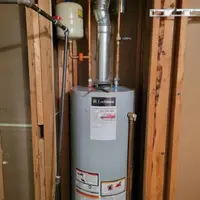
A burner consumes room air, and a sealed-up basement does not always have enough of it to give. An atmospheric gas water heater needs a defined volume of air around it to burn cleanly and to maintain draft; when a homeowner finishes a basement, adds a tight door to the utility room, or installs a powerful range hood or dryer nearby, the appliance can be pulled into starvation and spillage. The installation either confirms the space meets the required free volume, adds transfer grilles or a dedicated combustion-air duct, or moves the specification to a direct-vent unit that brings its own air from outside and takes the question off the table.
Gas Shutoff, Connectors And Code Approval
Each appliance gets its own accessible shutoff valve within reach of the unit, plus a sediment trap ahead of the control. The flexible connector between the shutoff and the gas valve is a listed appliance connector carrying a CSA or AGA certification mark, sized to the appliance input and never reused from the old tank. Joints are pressure-checked and leak-tested with solution or an electronic detector before the burner is fired for the first time — a step no gas installation should ever skip.
Standing Pilot Or Electronic Ignition
The ignition choice affects both the running cost and what happens after a Lancaster County power blip. A standing pilot burns a small continuous flame, needs no electricity, and relights with a match-free piezo igniter, which keeps a basement tank producing hot water straight through an outage. An electronic or intermittent ignition sparks the burner only on a call for heat, so no fuel is spent idling, but it needs a live receptacle to work at all. Homes prone to outages and without a generator often favour the standing pilot; efficiency-minded households with reliable power favour electronic. Lancaster Water Heater Pros lays out the trade for the specific home rather than defaulting to whatever is on the truck.
Ready To Price A New Gas Water Heater?
We size the gas line, confirm the vent path and quote the installed price before any work is scheduled.
Carbon Monoxide Safety During The Changeover
The riskiest hour of a gas water heater's life is the first one after it is connected. Once the burner fires, the installer verifies that the draft actually establishes — a lit match or smoke at the draft hood should be drawn upward, not blown back into the room — and re-checks it with the furnace and any exhaust fans running, because that combination is what unmasks a marginal flue. An orphaned water heater left alone on an oversized chimney after a furnace upgrade is a classic Lancaster failure mode and often needs the chimney relined to match the smaller load. A working CO alarm on the same level as the appliance closes out the job.
Permits And Timeline In Lancaster
Permit requirements for a gas water heater replacement vary by municipality; pulling the permit where one applies is the installer's responsibility. The installation is carried out to code for venting, gas connection and relief-valve discharge, then presented to the municipal inspector. A straight tank-for-tank swap where the gas line and vent already suit the new unit is typically a single-visit job of a few hours. Adding a larger gas branch, converting to power vent, or relining a chimney extends the work and is quoted up front rather than discovered mid-job. Installed pricing follows the range on the water heater installation in Lancaster, PA page, where a like-for-like gas replacement sits near the middle.
Survey And Size
Gas branch, vent path, combustion air and household hot-water demand are measured before a unit is selected.
Permit And Schedule
The municipal permit is pulled and the changeover is booked for a window that keeps the outage short.
Drain And Remove
Gas and water are isolated, the old tank is drained and carried out, and the space is prepared for the new unit.
Set, Connect And Vent
The tank is set level, plumbed with new connectors, fitted with a T&P discharge line, and vented to the listed clearances.
Fire And Prove Draft
Joints are leak-tested, the burner is lit, draft is confirmed under worst-case conditions, and the inspection is met.
Water Conditions And A New Gas Tank
On a gas tank the burner sits underneath the water, so every mineral that drops out of the supply lands directly in the path between the flame and the water it is meant to heat. That settled carbonate layer behaves like a blanket on the tank floor: the burner runs longer to push heat through it, the steel above the flame runs hotter than designed, and the glass lining is stressed at exactly the point it can least afford. On a mineral-heavy supply, that can pull a tank's service life well short of its 10–15 year rating. The install is the cheapest moment to plan against it — a full-port brass drain valve instead of the stock plastic one, enough clearance in front of it to actually attach a hose, and a first flush date set before the technician leaves.
Choosing An Installer For A Gas Water Heater
Gas work belongs with a contractor who handles the fuel side and the vent side as one system. Lancaster Water Heater Pros is family-owned, and has installed water heaters across Lancaster City and Lancaster County since 2018, staying with the same unit afterwards through gas water heater repair in Lancaster, PA. Households without a gas line should compare the electric water heater installation in Lancaster, PA option, and anyone weighing efficiency should look at heat pump water heater installation in Lancaster, PA before committing.
A gas water heater installation done properly is invisible afterwards: correct fuel volume, a vent that draws under load, air for the burner, and paperwork the inspector signs. Lancaster Water Heater Pros delivers that across Lancaster County.
 RheemPerformance Platinum
 A.O. SmithSignature Premier
 Bradford WhiteDefender, Vitraglas
 American StandardGas Storage Tanks