
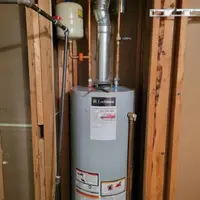
Specifying hot water for a business is a demand-modelling exercise, not a tank-shopping exercise. What matters is not how many gallons the vessel holds but how fast the system can put hot water back after the busiest sixty minutes of your trading day — and that answer is different for a dish pit, a guest floor, a bank of washers and a building full of apartments. Lancaster Water Heater Pros models that peak first, then specifies equipment, redundancy and a changeover schedule around it.
Recovery Rate Is The Number That Matters
Recovery rate — gallons per hour of water raised through a given temperature rise — is what separates a system that holds up from one that empties. Storage volume only buys you the opening minutes of a rush; after that, the business is running on whatever the unit can reheat in real time. A design that leans on a big vessel with modest recovery will look fine on a quiet morning and fail on a Saturday. The sizing therefore starts from your actual demand curve, and demand curves differ sharply by trade:
- Restaurants and cafés — sharp, repeated spikes around service periods, driven by the dish machine's sanitising cycles and pot-wash sinks rather than by hand washing.
- Hotels and lodging — one heavy, predictable morning block as guests shower in the same two hours, with laundry loading the same plant later in the day.
- Laundromats — sustained high draw across whole trading blocks rather than short peaks, which pushes the design toward recovery capacity above almost everything else.
- Multi-family buildings — overlapping household patterns that flatten into a broad morning and evening rise, sized on unit count and fixture mix.
Getting this wrong in either direction costs money: undersized recovery loses customers, while wildly oversized plant burns standby energy every hour of every day for capacity nobody uses.
Why Commercial-Grade Equipment, Not Bigger Residential
Chaining residential tanks together is a false economy that Lancaster businesses discover about eighteen months in. Commercial-grade units are built with substantially higher input ratings, heavier gauge vessels, more robust anodes and controls, and they are rated for the duty cycle a business actually imposes — dozens of heavy draws a day rather than a handful. Residential equipment installed in a commercial setting also runs into warranty terms that exclude commercial use, so the first failure is uncovered as well as premature. The higher input rating brings its own requirements: a larger gas supply, correspondingly sized venting, and adequate combustion air, all of which are designed in at the start rather than discovered at inspection.
Need Hot Water Sized For Your Business?
We survey the site, model your peak-hour demand and quote a system that holds up on your busiest day.
Redundancy And Multi-Unit Configurations
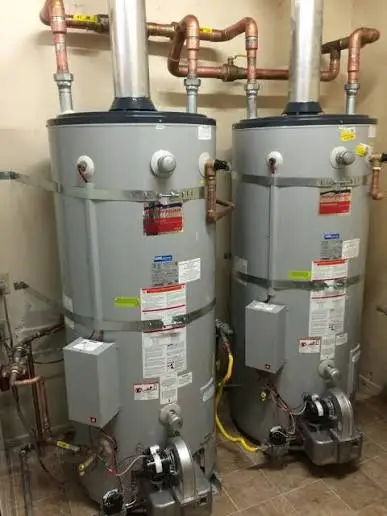
A single large vessel is a single point of failure, and for a business that is a trading risk rather than an inconvenience. Splitting the same total capacity across two or more units means a failure degrades service instead of stopping it: the kitchen keeps running at reduced capacity while one unit is repaired, and routine maintenance can be carried out on one unit during trading hours without shutting anything down. Multiple smaller units also track a variable load more efficiently, since plant can be staged in as demand climbs instead of one oversized burner cycling against a light load all afternoon. Where floor space allows it, this is usually the stronger specification for restaurants and lodging in particular.
Commercial Code And Inspection
Commercial water heater work sits under a different and more demanding review than a house. The installation is carried out to Pennsylvania Uniform Construction Code requirements as they apply to the commercial occupancy, permitted with the authority having jurisdiction, and inspected before the system is signed over. The areas that draw the most attention are relief-valve discharge routing, seismic and structural restraint where required, backflow protection, gas piping and venting sized to the higher input, and clearances that leave the equipment genuinely serviceable. Scald protection through thermostatic mixing also comes into play where storage temperature is elevated to gain effective capacity. Documentation is prepared as part of the job rather than chased afterwards.
Installing Around Your Trading Hours
The changeover is scheduled to fall outside your revenue window, because for most of our commercial clients downtime is the largest line in the true cost of the project. That commonly means overnight work for a restaurant, a mid-week low-occupancy window for lodging, or a phased sequence in multi-family and multi-unit installations where one unit is brought online before the next is taken out, so the building is never entirely without hot water. Temporary provision can be arranged where a full outage is unavoidable. The sequence is agreed in writing before work starts, so the business knows exactly which hours are affected.
Running Cost And Payback
On commercial plant the purchase price is a small share of what the system costs over its life — the energy it consumes is the rest. A high-efficiency condensing unit carries a higher capital cost and returns it through fuel consumption that a business running heavy daily volume feels immediately, which is why the payback period shortens as usage rises: the same efficiency gain is worth far more to a laundromat than to a low-volume office. Properly matched capacity contributes as well, since plant sized close to real demand spends less of the day maintaining water nobody draws. We set out the projected running cost alongside the capital cost so the decision is made on total cost rather than on the invoice for the equipment.
Survey And Model Demand
Fixture count, equipment schedule and your actual peak trading hour are recorded to establish the required recovery.
Specify Capacity And Redundancy
Recovery, storage and the single-versus-multiple-unit decision are settled against the demand model.
Design Services And Permit
Gas supply, venting, combustion air and relief discharge are designed to the higher input and the permit is filed.
Phase The Changeover
Work is sequenced outside trading hours, bringing capacity online before existing plant is removed.
Commission And Hand Over
Output is verified against the design peak, mixing valves are set, and the inspection and documentation are completed.
Water Conditions And Commercial Capacity Planning
Water conditions are a sizing input on commercial plant, not merely a maintenance footnote. Scale deposits in proportion to the volume of water passing through the equipment, so a system moving many times a household's daily throughput accumulates mineral load many times faster. The consequence is that measured recovery on a commercial unit falls away from its rated figure over the year — and a system specified with no margin above the design peak will meet the requirement in month one and fail it by month twelve. We therefore specify recovery with deliberate headroom above modelled peak demand, discuss whether treatment ahead of the plant is justified for your throughput, and build a descaling interval into the handover documentation rather than leaving it to be discovered when service degrades.
Who Should Install Commercial Water Heating
The right contractor is one who models your demand before quoting equipment and who will still answer the phone when the system is down mid-service. Lancaster Water Heater Pros is family-owned and has served Lancaster City and Lancaster County since 2018, supporting every system it installs through commercial water heater repair in Lancaster, PA. Smaller premises sometimes size closer to residential equipment, in which case the water heater installation in Lancaster, PA page is the better starting point, and a tankless water heater installation in Lancaster, PA can suit sites with a long, steady draw and limited plant space.
Commercial hot water is specified correctly when it survives your busiest hour in the twelfth month, not just the first. Lancaster Water Heater Pros designs to that standard across Lancaster County.