
American Standard’s residential water heater range is entirely storage tank — gas and electric, in a spread of capacities and venting arrangements, with no tankless model in it. That single fact shapes every decision around the brand, because it means a household already committed to a tank has a wide set of choices, and a household thinking about going tankless has to look elsewhere. This review works from what American Standard publishes on its own site: the lines it lists, the specifications attached to them, the warranty terms it prints, and one significant question its published record does not answer.
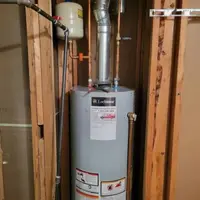
The Quick Answer: Who American Standard Suits
American Standard suits a property replacing a storage tank with a storage tank, where the fuel and the venting route are already settled. The range covers both fuels across a wide capacity spread, which means a like-for-like replacement rarely forces a change to the gas line, the flue or the electrical service — and those changes are what turn a swap into a project. What the range does not offer is an in-brand route to tankless, so a household weighing that move is choosing between American Standard and a different manufacturer, not between two American Standard products.
There is a second thing worth knowing before a quote arrives, and it is about the paperwork rather than the hardware. American Standard states that it works only with qualified and licensed representatives and runs a distributor and service contractor locator, and its warranty page marks claim filing as distributors only. In practice that means the route to warranty support runs through the trade rather than direct from the homeowner, which is worth establishing at the point of purchase rather than at the point of failure.
What American Standard Actually Lists For Homes
American Standard’s residential index names two subcategories: electric water heaters and gas water heaters. Everything below sits inside one of those two. The distinctions between lines within each fuel come down to connection layout, venting method, emissions rating and capacity rather than to a tiered good-better-best structure, which makes the line-up straightforward to read off a spec sheet.
The Electric Lines
American Standard lists Top Connect in 30, 40 and 50 gallon capacities across tall, high and low boy configurations, on 208 or 240 volt single phase, with up to 6,000 watts of input, up to .93 UEF and up to 60 gallons first-hour rating. It specifies dual low-watt-density Incoloy heating elements, fully automatic surface-mounted thermostats, a full port brass drain valve and a magnesium anode rod, and lists the line as AHRI Certified.
Demand Response Top Connect sits alongside it in 40 and 50 gallon capacities, which American Standard lists at up to .93 UEF and up to 67 gallons first-hour rating, and describes as EcoPort certified and demand response ready. Low Boy Side Connect covers 30, 40 and 50 gallon in a side-connected low profile, and Point of Use runs small — American Standard lists 2½, 6, 12 and 20 gallon capacities with a single low-watt-density Incoloy element, which is the under-sink and remote-fixture end of the range rather than a whole-house option.
The Gas Lines
American Standard lists Power Vent in 40 and 50 gallon capacities in short and tall configurations, at 40k, 50k and 63k BTU input, up to .71 UEF and up to 110 gallons first-hour rating, operating on natural and LP gas. The atmospheric lines run lower and simpler: Ultra-Low NOx Atmospheric and Low NOx Atmospheric are both listed in 30, 40 and 50 gallon capacities at up to 40k BTU input, up to .66 UEF and up to 86 gallons first-hour rating.
Above those sit the heavy duty atmospheric versions, which American Standard lists in 75 and 100 gallon capacities at 76k and 80k BTU input and up to .60 UEF — the Low NOx version at up to 135 gallons first-hour rating on natural and LP gas, and the Ultra-Low NOx version at up to 125 gallons on natural gas. Those are residential-listed but sized for properties with genuinely heavy simultaneous demand, and they bring a venting and combustion-air requirement to match.
Working out which line is already in your basement? Call (717) 500-8528 with the model number off the rating plate.
What The Power Vent Line Carries
The Power Vent line is where American Standard’s published feature detail sits, and it is worth reading before comparing a Power Vent unit to an atmospheric one on price alone. American Standard lists built-in gas pressure regulation, a flammable vapour sensor, Vaporshield technology, a full port brass drain valve and an aluminium anode rod, and it lists the line as AHRI Certified. It also specifies an LED control light that shows operational status and diagnostic information for troubleshooting.
That last item is the one that changes a service call rather than a spec sheet. A status light that encodes a fault condition gives a technician a starting point before anything is opened, in the same way an error code does on a wall-mounted unit. It does not replace the diagnosis, but it narrows where the diagnosis starts — and it is a practical argument for keeping the manual with the unit, since the code is only useful alongside the table that decodes it.
The anode difference between the two lines is also worth noting at replacement time rather than discovering later: American Standard specifies an aluminium anode rod on Power Vent and a magnesium anode rod on Top Connect. Anode material is a serviceable item with different replacement characteristics, so it belongs on the list of things to confirm from the specification sheet for the exact model rather than assumed across the range.
Warranty: What Is Published, And What Carries An Asterisk
American Standard lists “Tank Warranty: 6 or 12 years” and “Part Warranty: 6 years” on both the Power Vent gas line and the Top Connect electric line. Separately, its homepage advertises a “Standard 12-year warranty* available on select products”. The asterisk and the words “select products” are doing real work there: a 12-year figure attaches to some products under some conditions, not to the range as a whole, and the product page ranges of 6 or 12 years say the same thing more plainly.
The mechanics are documented. American Standard runs warranty registration through an online tool it calls the Warranty Wizard, and its warranty page directs owners to contact their local installer or plumber for warranty service while marking claim filing as distributors only. What that adds up to is a chain that depends on the installing contractor still being reachable, which is a reason to keep the registration confirmation and the installer’s details with the unit’s paperwork rather than in a drawer somewhere.
The Tankless Question, And Why This Page Leaves It Open
American Standard’s own site lists no residential tankless product. Its products index, its residential products index and its downloadable document library all cover gas and electric storage, and none of the three carries a tankless product page or a tankless manual. A third-party manual repository does host a document titled for an American Standard residential tankless condensing unit, quoting a flow figure, but that document is not corroborated anywhere in American Standard’s published record.
Two possibilities fit that evidence equally well: a discontinued product whose documentation survives outside the manufacturer’s site, or a document that does not belong to this range at all. We cannot tell which from the material available, so we record the conflict instead of picking the more convenient reading. If you have a unit in front of you that appears to be an American Standard tankless, the rating plate and the serial number are the way to settle it — not a search result.
What This Review Does Not Claim About The Brand
We do not state who manufactures American Standard water heaters, because American Standard does not state it either. Its homepage, its product pages and its residential index describe the brand and specify the products without naming a manufacturer, a parent company or a licensing arrangement. A shared name, a familiar logo, a retailer listing or a similar-looking cabinet is not evidence of a corporate relationship, and the previous version of our own American Standard page carried a licensing statement that we could not support against the published record. That statement has been retracted.
Nor does the absence of a published ownership statement say anything against the brand. Plenty of manufacturers publish nothing about corporate structure on a consumer-facing product site, and treating silence as a finding would be the same error in the opposite direction. What matters for a service call is the model number, the documentation that exists for it, and the parts that match — all three of which American Standard does publish, freely and without a login.
What A Service Call On An American Standard Unit Involves
The work starts at the rating plate, not at the brand. A storage tank is diagnosed by fuel and configuration rather than by badge, so the sequence is the same one that applies to any tank in a Lancaster County basement — with the brand determining which documentation and which parts get pulled.
- Identify the unit. Model and serial from the rating plate, fuel type, input rating, and on an electric unit the element wattage and the supply voltage — 208 or 240 volt single phase on the Top Connect line.
- Check fuel, venting and configuration. A Power Vent unit and an atmospheric unit fail differently and vent differently, and a tall, high or low boy cabinet changes what physically fits back into the space.
- Pull the documentation. American Standard publishes manuals and specification sheets for download, so the correct fault table, part list and clearance figures are available for the exact model before a part is ordered.
- Diagnose, then price the decision. On a gas unit that means the control, the ignition path and the venting; on an electric unit the elements, the thermostats and the high-limit reset. What that costs against the cost of replacing the tank is the conversation worth having with the tank’s age in front of you.
For the general version of that sequence, our water heater repair page for Lancaster, PA covers it across all brands, with the fuel-specific detail on gas water heater repair and electric water heater repair. If the tank turns out to be past repair, water heater installation in Lancaster, PA covers sizing and the replacement itself, and our water heater repair cost guide sets out what drives the number.
American Standard’s Residential Range At A Glance
| Line | Fuel | Capacities listed | Published efficiency |
|---|---|---|---|
| Top Connect | Electric | 30, 40, 50 gal | Up to .93 UEF |
| Demand Response Top Connect | Electric | 40, 50 gal | Up to .93 UEF |
| Low Boy Side Connect | Electric | 30, 40, 50 gal | Not listed on the line page |
| Point of Use | Electric | 2½, 6, 12, 20 gal | Not listed on the line page |
| Power Vent | Gas | 40, 50 gal | Up to .71 UEF |
| Ultra-Low NOx Atmospheric | Gas | 30, 40, 50 gal | Up to .66 UEF |
| Low NOx Atmospheric | Gas | 30, 40, 50 gal | Up to .66 UEF |
| Heavy Duty Atmospheric | Gas | 75, 100 gal | Up to .60 UEF |
Compare within a fuel column rather than across the two. A gas figure and an electric figure sit on different fuels at different local prices, so the comparison that helps is against another unit that could physically go into the same space.
How American Standard Sits Against The Other Brands We Service
An all-tank range is a narrower proposition than a range spanning both categories, and that is the honest framing. Against a manufacturer whose range spans tank and tankless, choosing American Standard settles the category before the model. Against a tankless-only manufacturer it is the opposite trade. Neither is better in the abstract — what decides it is whether the property is staying with a tank.
The reviews we have written on the others set out the same kind of published detail: Rheem and A.O. Smith both span tank and tankless, Bradford White is gas-led with its own distribution model, and Navien, Rinnai and Noritz are the tankless side of the comparison. For American Standard service specifically, our American Standard water heater repair page covers the work across Lancaster County.
No Hot Water From An American Standard Tank?
Service requests and emergency service are available 24/7 across Lancaster City and Lancaster County.
Call For Emergency ServiceAmerican Standard Water Heater Questions
What water heaters does American Standard make for homes?
American Standard lists residential electric and residential gas storage water heaters, and nothing else. On the electric side it lists Top Connect, Demand Response Top Connect, Low Boy Side Connect and Point of Use. On the gas side it lists Power Vent, Ultra-Low NOx Atmospheric, Low NOx Atmospheric and heavy duty atmospheric versions of both. Its residential index names two subcategories, electric and gas — there is no third.
What warranty comes with an American Standard water heater?
American Standard lists “Tank Warranty: 6 or 12 years” and “Part Warranty: 6 years” on both its Power Vent gas line and its Top Connect electric line. Its homepage separately advertises a “Standard 12-year warranty* available on select products”, with the asterisk carrying the qualification. Registration runs through American Standard’s own online Warranty Wizard, its warranty page directs owners to contact their local installer or plumber for warranty service, and it marks warranty claim filing as distributors only.
Who manufactures American Standard water heaters?
American Standard Water Heaters publishes no manufacturer, parent company or licensing statement on its own site, so this page does not state one. Its product pages, residential index and homepage describe the brand and its products without naming who builds them. Rather than fill that gap with an inference from a name or a logo, we treat the question as unanswered in the published record and work from the model and serial number on the rating plate instead.
Does American Standard make a tankless water heater?
Not in the residential range it currently publishes. Its products index, its residential products index and its downloadable document library list gas and electric storage only, with no tankless product and no tankless manual. A third-party manual repository does carry a document titled for an American Standard residential tankless condensing unit, which American Standard’s own site does not corroborate. We record that conflict rather than resolve it, and state neither version as fact.
How do I identify my American Standard water heater before a repair?
Work from the rating plate on the side of the tank. It carries the model and serial number, the fuel type, the input rating and, on electric units, the element wattage and voltage. American Standard publishes manuals, specification sheets, product catalogs and sales brochures for download without a login, so once the model number is in hand the documentation for that exact unit is available before anyone quotes a part.
Do you repair American Standard water heaters near me in Lancaster County?
Yes. Lancaster Water Heater Pros services American Standard gas and electric storage tanks across Lancaster City and Lancaster County, covering zip codes 17601, 17602 and 17603 and the surrounding boroughs and townships. Call (717) 500-8528 with the model number from the unit’s rating plate.