
Rinnai is a tankless-first brand, and the choice inside it comes down to two questions: condensing or non-condensing, and whether you want recirculation built in. Those two answers pick the series — RU, RUR or RL — and the first of them also decides how the unit vents, which is the part of a Rinnai install that shapes the quote. This review covers what separates the series, why venting deserves attention before anything else, and which components a technician ends up servicing.
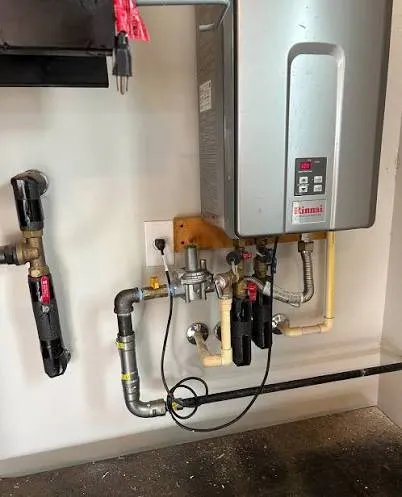
The Quick Answer: Who Rinnai Suits
Rinnai suits a household that wants continuous hot water and has a gas supply and a practical venting route to the outside. Like any tankless brand, it is not a like-for-like swap for a storage tank: the venting changes, the gas sizing may change, and a condensing model adds a drain. Where that work is viable, the decision narrows to the series — and the series follows from where the unit can be mounted and how it can be vented.
Rinnai’s Residential Tankless Lines
Rinnai groups its residential tankless range by condensing and non-condensing designs, with SENSEI as the name for its condensing ranges. Per Rinnai’s own residential listings:
| Series | Design | Notes from Rinnai’s listings |
|---|---|---|
| SENSEI RU | Condensing | RU199iN listed at 0.95 UEF, 15,000 to 199,000 BTU/h, indoor |
| SENSEI RUR | Condensing, recirculating | Built-in pump and Circ-Logic; RUR199iN listed at 0.93 UEF |
| RL | Non-condensing | Wi-Fi monitoring and recirculation technology |
| SENSEI RX | Condensing | Listed at 0.98 UEF |
Rinnai states its tankless water heaters are available with natural gas or propane fuel options, and can be installed inside or outside — though that varies by model, and the RU199iN and RUR199iN listed above are indoor natural gas units. The fuel and the mounting location are fixed by the model number, so they are worth settling first.
Two labels appear on the RU199iN and RUR199iN spec sheets and are worth decoding on a quote. Rinnai lists both as ENERGY STAR certified for residential use, and as SCAQMD approved Ultra Low NOx. SCAQMD is the South Coast Air Quality Management District, a California air-quality regulator, so that approval describes the unit’s nitrogen-oxide emissions performance rather than anything specific to a Pennsylvania installation. The RL sits apart from both condensing series: as a non-condensing design it needs no condensate drain, which can simplify a retrofit where there is nowhere convenient for condensate to go. Rinnai labels the RL high-efficiency-plus, where it labels the SENSEI RU super-high-efficiency-plus; it does not publish a UEF for the RL on its series page, so the two cannot be compared directly here. That trade is a building question more than a brand one.
Been quoted a Rinnai and unsure which series it is? Call (717) 500-8528 with the model number.
Talk To A TechnicianVenting: The Question That Shapes A Rinnai Install
Venting is where a tankless quote gains or loses scope, and it follows directly from whether the unit condenses. A condensing unit pulls extra heat out of its own exhaust, which leaves that exhaust cool enough to run through plastic. Rinnai lists PVC, CPVC and polypropylene venting for the RU199iN, and adds Centrotherm systems for the RUR199iN. Cooling the exhaust that far also condenses water out of it, so a condensing model needs a drain for that condensate.
A non-condensing unit such as the RL skips the condensate but sends out hotter exhaust, which changes what it can vent through and how. Neither design is automatically the better choice; the building decides. A short, direct route to an outside wall favours one arrangement, a long run through finished space another, and an outdoor-rated model can remove the interior vent question altogether where the climate and siting allow it.
The exact vent material, route and maximum length come from the installation manual for the specific model and vent type — Rinnai publishes a separate installation document for each. That is the document a quote should be built from, rather than a rule of thumb.
RU Or RUR: The Recirculation Decision
Between the two condensing SENSEI series, the practical difference is recirculation. Rinnai describes the RUR as having a built-in pump and its Circ-Logic technology, which lets the owner set recirculation patterns that coincide with household habits. The point is to shorten the wait between opening a tap and hot water arriving, which a tankless unit otherwise has while the burner comes up to temperature and the pipe run clears.
That comes at a small rated cost: Rinnai lists the RU199iN at 0.95 UEF and the RUR199iN at 0.93. Whether the recirculating model is worth it depends on the plumbing layout. A long run to the furthest bathroom makes the wait noticeable; a compact layout makes it marginal. As with any UEF figure, read those as standardised ratings rather than a forecast — draw pattern, inlet temperature and gas rates move real running cost, and the rating accounts for none of them.
Which Rinnai Components Get Serviced
A tankless unit has no tank to corrode, but more parts that need to stay clear and calibrated.
- Heat exchanger — where scale builds in water that carries a heavy mineral load. Descaling on the manufacturer’s schedule is the main preventative task on any tankless unit.
- Condensate drain and trap — on the condensing RU, RUR and SENSEI RX. A blocked condensate path shuts a healthy unit down.
- Flow sensor — tells the unit water is moving; when fouled, output turns intermittent or lukewarm.
- Igniter, flame rod and burner — prove and sustain combustion, and a failure here surfaces as a fault code rather than silence.
- Recirculation pump — on the RUR, a moving part the RU does not have.
- Venting and air intake — a blocked or incorrectly terminated vent is a safety fault, not a performance one.
Fault codes make tankless diagnosis faster than tank work, provided the technician reads that model’s codes. Component-level detail sits on the tankless water heater repair page.
What To Check Before You Buy A Rinnai
Going tankless is an installation decision before it is a product decision. Settle five things: the gas type, since the model is fixed to natural gas or propane; the gas supply and its run length; the venting route, which decides condensing or non-condensing; somewhere for condensate to drain on a condensing model; and whether recirculation is worth the RUR. Sizing also works differently from a tank. A tankless unit is sized by flow rate and by the temperature rise it has to deliver, and that rise is largest in winter when incoming water is coldest — so a maximum flow figure quoted without its temperature rise tells you little. The tankless water heater installation page covers that scope, and the cost guide covers the published planning ranges.
Comparing Rinnai against Navien on a quote? Our Rinnai and Navien tankless comparison sets the two ranges side by side on published specifications only.
Rinnai Service In Lancaster County
Tankless units reward a technician who works on them regularly, because fault codes, descaling and the vent run are where a visit starts. Lancaster Water Heater Pros services Rinnai condensing and non-condensing tankless units across Lancaster City and Lancaster County, covering zip codes 17601, 17602 and 17603 along with the surrounding boroughs and townships. Where a fault sits in the heat exchanger, the recirculation pump or the vent, the Rinnai water heater repair page covers what that service call involves.
Photographing the rating plate before a visit saves a return trip, since the model and serial number tell a technician the series, fuel and age. If you are weighing Rinnai against the other condensing tankless brand, our Navien condensing tankless review covers the NPE-A2 and NPE-S2; the Rheem, A.O. Smith and Bradford White reviews cover the tank-led alternatives.
Rinnai Tankless FAQ
What is the difference between the Rinnai RU and RUR series?
Both are condensing SENSEI models; the RUR adds recirculation. Rinnai describes the RUR series as having a built-in pump and its Circ-Logic technology, which lets the owner set recirculation patterns to match household habits. Rinnai lists a UEF of 0.95 for the RU199iN and 0.93 for the RUR199iN, so the recirculating model trades a small amount of rated efficiency for the pump.
Is the Rinnai RL series condensing?
No — Rinnai describes the RL series as non-condensing. Rinnai lists Wi-Fi monitoring and recirculation technology on the RL. A non-condensing unit produces no condensate, but its exhaust is hotter, so it vents differently from the condensing RU and RUR, and where the unit can be mounted decides which of the two makes sense.
What venting does a Rinnai condensing tankless need?
Rinnai lists PVC, CPVC and polypropylene venting for the RU199iN, and adds Centrotherm systems for the RUR199iN. Condensing units run cooler exhaust, which is what allows plastic venting. The exact material, route and maximum length come from the installation manual for the specific model and vent type, so venting is settled from that document rather than from a general rule.
Does Rinnai make a tankless unit for propane?
Yes — Rinnai states its tankless water heaters are available with natural gas or propane fuel options. Fuel type is fixed by the model ordered, so confirm which gas the house has before the model number is settled. The RU199iN and RUR199iN listed here are natural gas models.
What is SENSEI on a Rinnai?
SENSEI is the name Rinnai uses for its condensing tankless ranges, covering the RU and RUR series and the SENSEI RX. Rinnai lists the SENSEI RX at 0.98 UEF. The name identifies a condensing design; it does not by itself tell you whether a unit recirculates or which vent materials it takes, so check the model number for those.
Do you repair Rinnai tankless water heaters near me in Lancaster County?
Yes. Lancaster Water Heater Pros services Rinnai condensing and non-condensing tankless units across Lancaster City and Lancaster County, covering zip codes 17601, 17602 and 17603 and the surrounding boroughs and townships. Call (717) 500-8528 with the model number from the unit’s rating plate.